
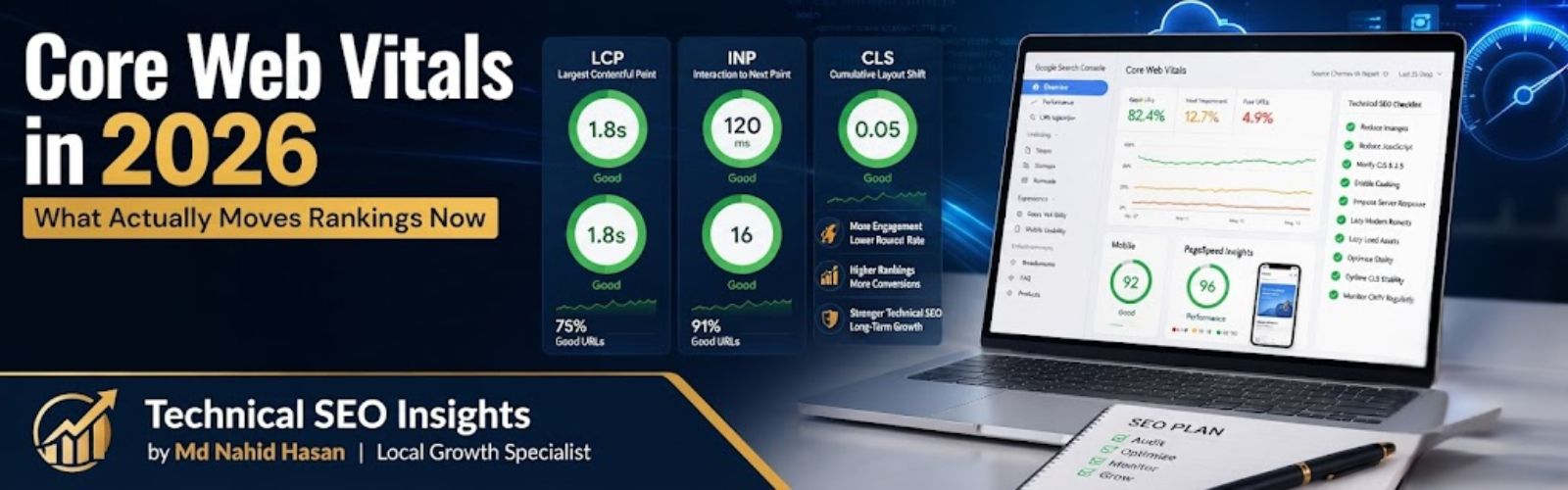
Core Web Vitals continue to be an important part of Technical SEO because they measure how real users experience a website. Many business owners believe improving these metrics alone will dramatically increase rankings. In reality Google's ranking systems evaluate hundreds of signals together including helpful content, search intent, technical quality and overall user experience.
A fast website creates a better experience for visitors but speed alone cannot compensate for weak content or pages that fail to answer user questions.
Whether you manage a local business website, an online store or a service-based company understanding how Core Web Vitals fit into modern SEO helps you make smarter optimization decisions.
This guide explains what Core Web Vitals are, whether they still influence rankings in 2026 and how they work alongside Google's broader ranking systems.
What Are Core Web Vitals?
Featured Answer:
Core Web Vitals are a set of user experience metrics created by Google to measure how quickly a webpage loads, how responsive it feels and how visually stable it remains while loading. They are part of Google's Page Experience evaluation but they represent only one group of signals among many that influence search performance.
The three Core Web Vitals currently measured are:
- Largest Contentful Paint (LCP)
- Interaction to Next Paint (INP)
- Cumulative Layout Shift (CLS)
These metrics help website owners identify technical problems that affect real visitors instead of focusing only on synthetic speed tests.
Purpose Of Core Web Vitals
The primary purpose of Core Web Vitals is improving the experience users have while interacting with a webpage.
Google wants websites to load efficiently, respond quickly to user actions and remain visually stable throughout the loading process.
Better user experience often leads to:
- Lower bounce rates
- Longer engagement
- Higher customer satisfaction
- Improved conversions
- Greater trust
Although these improvements may support stronger SEO performance over time they should always be viewed as part of a broader optimization strategy.
How Core Web Vitals Relate To User Experience
Core Web Vitals measure the actual experience visitors have when using your website.
Imagine a customer searching for a local contractor.
If the page loads slowly, buttons respond with noticeable delays or the content suddenly shifts while they attempt to click a phone number the experience becomes frustrating.
These usability problems can reduce customer confidence and increase the likelihood that users leave the website before contacting the business.
Improving Core Web Vitals helps reduce these issues and creates a smoother browsing experience.
How Core Web Vitals Relate To Google Search
Google has confirmed that Core Web Vitals are included within its Page Experience signals.
However they are only one part of Google's ranking systems. Businesses that want to rank higher on Google Maps should also focus on creating helpful content, optimizing their Google Business Profile and improving the overall user experience.
Helpful content, search relevance, page quality and overall usefulness remain significantly more important when determining which pages best satisfy a search query.
When two pages provide similar value the page offering the better user experience may have an advantage.
This means website owners should improve Core Web Vitals while continuing to prioritize helpful content and customer-focused information.
Core Web Vitals vs Page Speed
Many people assume Core Web Vitals and Page Speed are the same thing.
They are closely related but they measure different aspects of website performance.
Page Speed generally refers to how quickly a webpage loads.
Core Web Vitals measure how users experience that loading process including responsiveness and visual stability.
A page may achieve a fast loading time while still providing a poor experience if buttons respond slowly or content unexpectedly moves during loading.
Likewise a page with average speed can still provide an excellent user experience when interactions remain smooth and stable.
Do Core Web Vitals Still Matter In 2026?
Yes.
Core Web Vitals continue to matter in 2026 because they remain part of Google's Page Experience evaluation.
However they should never be viewed as the primary factor determining rankings.
Google's ranking systems continue to prioritize content that satisfies user intent, demonstrates expertise and provides trustworthy information.
Core Web Vitals Remain A Ranking Signal
Google has not removed Core Web Vitals from its ranking systems.
Websites with poor user experience may place themselves at a disadvantage compared with pages offering similar content and stronger usability.
Improving website performance therefore remains a worthwhile investment for both SEO and customer satisfaction.
Helpful Content Matters More
A website with exceptional Core Web Vitals but weak content is unlikely to outperform a page that answers user questions thoroughly.
Helpful information, topical relevance and satisfying search intent continue to play a larger role in Google's ranking systems.
Business owners should avoid treating Technical SEO as a replacement for high-quality content.
User Experience Influences Conversions
Even if Core Web Vitals have only a modest influence on rankings they can have a much greater impact on business performance.
Fast and responsive websites often generate:
- More completed contact forms
- Higher online sales
- More phone calls
- Longer user engagement
- Greater customer confidence
These improvements make website optimization valuable beyond search rankings alone.
Technical SEO Supports Overall Website Quality
Core Web Vitals should be viewed as one component of a complete Technical SEO strategy.
Other important areas include:
- Website crawlability
- Mobile usability
- Structured data
- Secure HTTPS connections
- Internal linking
- Indexing
- Image optimization
- Server performance
Businesses that improve these technical foundations while publishing helpful content usually create stronger long-term search performance than businesses focusing on a single optimization metric.
The Three Core Web Vitals Explained
Core Web Vitals measure three different aspects of website performance. Together they help website owners understand how quickly a page loads, how responsive it feels and whether the layout remains stable while visitors interact with it.
Each metric focuses on a different part of the user experience. Improving all three creates a faster and more enjoyable website for your visitors.
Largest Contentful Paint (LCP)
Largest Contentful Paint measures how long it takes for the largest visible element on a webpage to appear.
In most cases this element is a large image, banner or headline that users immediately notice after opening the page.
Google considers a good Largest Contentful Paint score to be 2.5 seconds or less.
Good LCP Score
- Good: 2.5 seconds or less
- Needs Improvement: 2.5–4.0 seconds
- Poor: More than 4.0 seconds
Common Causes Of Poor LCP
- Large uncompressed images
- Slow web hosting
- Render-blocking CSS
- Heavy JavaScript files
- Slow server response time
- Too many third-party scripts
How To Improve Largest Contentful Paint
- Compress large images
- Use WebP or AVIF image formats
- Enable browser caching
- Use a Content Delivery Network (CDN)
- Reduce server response time
- Minify CSS and JavaScript
- Preload important resources
For many business websites optimizing images produces one of the quickest improvements in Largest Contentful Paint.
Interaction To Next Paint (INP)
Interaction to Next Paint measures how quickly a webpage responds after a visitor interacts with it.
This includes actions such as:
- Clicking a button
- Opening a menu
- Submitting a form
- Selecting a navigation item
INP replaced First Input Delay because it provides a more complete measurement of website responsiveness throughout the entire visit rather than only measuring the first interaction.
Good INP Score
- Good: 200 milliseconds or less
- Needs Improvement: 200–500 milliseconds
- Poor: More than 500 milliseconds
Common Causes Of Poor INP
- Heavy JavaScript execution
- Large JavaScript libraries
- Too many browser events
- Long-running scripts
- Third-party widgets
- Poor front-end optimization
How To Improve INP
- Reduce unnecessary JavaScript
- Split large JavaScript files
- Delay non-essential scripts
- Remove unused plugins
- Optimize event handlers
- Reduce third-party scripts
Improving responsiveness creates a smoother experience for visitors especially on mobile devices.
Cumulative Layout Shift (CLS)
Cumulative Layout Shift measures how much page elements unexpectedly move while the page is loading.
Almost everyone has experienced clicking a button only to have the page suddenly shift causing the wrong element to be selected.
CLS measures these unexpected layout movements.
Good CLS Score
- Good: 0.1 or lower
- Needs Improvement: 0.1–0.25
- Poor: Above 0.25
Common Causes Of Poor CLS
- Images without width and height attributes
- Advertisements loading late
- Fonts changing during loading
- Embedded videos without reserved space
- Dynamically inserted content
How To Improve CLS
- Specify image dimensions
- Reserve space for advertisements
- Use properly optimized web fonts
- Avoid inserting content above existing elements
- Preload important fonts
Reducing layout shifts helps visitors interact with your website confidently without unexpected movement.
Core Web Vitals vs Page Speed
Many website owners believe Core Web Vitals and Page Speed are identical. Although they are closely related they measure different aspects of website performance.
The comparison below explains the differences.
| Factor | Core Web Vitals | Page Speed |
|---|---|---|
| Main Focus | Real user experience | Loading performance |
| Measures | LCP, INP and CLS | Overall loading speed |
| Primary Goal | Improve usability | Reduce loading time |
| Google Uses | Page Experience signal | Performance evaluation |
| User Interaction | Measured | Limited |
| Visual Stability | Measured | Not directly measured |
| Responsiveness | Measured through INP | Not the main focus |
| Overall Experience | Complete user experience | Website speed only |
A website can load quickly but still provide a poor experience if buttons respond slowly or page elements shift unexpectedly.
Likewise a page with average loading speed may still offer an excellent experience when interactions remain smooth and visually stable.
What Actually Moves Rankings In 2026?
One of the biggest misconceptions in SEO is believing that improving Core Web Vitals alone will dramatically improve rankings.
Google's ranking systems evaluate many signals together. Core Web Vitals contribute to overall page quality but they are only one part of a much larger picture.
Helpful Content
The strongest ranking signal remains content that genuinely helps users solve their problems.
Pages should answer questions clearly, demonstrate expertise and satisfy search intent better than competing pages.
Search Intent
Google aims to match every search with the most relevant result.
Understanding what users actually want is often more important than improving a few milliseconds of loading time.
Topical Authority
Websites publishing comprehensive content around a specific topic often build stronger authority over time.
Creating related articles that support each other through internal linking helps search engines understand your expertise.
Experience And Trust
Businesses that demonstrate real experience, transparent information and trustworthy content usually create greater confidence for both users and search engines.
Technical SEO
Technical SEO ensures your content can be crawled, indexed and displayed efficiently.
Core Web Vitals are one component of Technical SEO alongside structured data, mobile usability, HTTPS security, XML sitemaps and clean site architecture.
Website Usability
A website should be easy to navigate on both desktop and mobile devices.
Clear navigation, readable typography and accessible design improve the overall user experience.
Internal Linking
Well-planned internal links help visitors discover related content while allowing search engines to understand the relationship between your pages.
Backlinks
High-quality backlinks from relevant websites continue to strengthen authority and trust when earned naturally. They become even more effective when supported by accurate local citations that reinforce your business information across trusted directories.
Google Business Profile For Local Businesses
For businesses serving specific locations an optimized Google Business Profile remains an essential part of local search visibility.
Website performance, helpful content and local optimization work together rather than competing with one another.
How These Signals Work Together
The most successful websites combine helpful content, excellent user experience, strong Technical SEO, trustworthy information and fast website performance.
Rather than chasing a perfect PageSpeed score focus on creating a website that genuinely serves your visitors. Core Web Vitals support that goal but they should always be part of a complete SEO strategy instead of the only objective.
How To Improve Core Web Vitals
Improving Core Web Vitals requires a combination of technical optimization and continuous monitoring. The goal is creating a faster, more responsive and more stable experience for your visitors rather than chasing a perfect performance score.
1. Optimize Images
Large images are one of the most common causes of poor Largest Contentful Paint.
Reduce image sizes before uploading them and choose modern formats that maintain quality while reducing file size.
Best practices include:
- Compress images before upload
- Resize images appropriately
- Avoid unnecessarily large hero images
- Use responsive images
2. Use Modern Image Formats
Modern formats such as WebP and AVIF usually provide better compression than JPEG or PNG while maintaining excellent visual quality.
Smaller images load faster and reduce bandwidth usage.
3. Enable Lazy Loading
Lazy loading delays images and videos that are outside the visible screen until users scroll to them.
This reduces the amount of content loaded during the initial page visit.
4. Reduce JavaScript
Large JavaScript files can slow page responsiveness and negatively affect Interaction to Next Paint.
Review unnecessary plugins, remove unused scripts and split large JavaScript files whenever possible.
5. Improve Server Response Time
A slow server delays every page request.
Choose reliable hosting, optimize your database and consider using a Content Delivery Network to improve response times for visitors in different regions.
6. Enable Browser Caching
Browser caching allows returning visitors to load pages more quickly by storing static resources on their devices.
This reduces repeated downloads and improves overall performance.
7. Optimize Fonts
Poorly optimized fonts can delay rendering and contribute to layout shifts.
Preload important fonts and limit the number of font families used across your website.
8. Reduce Layout Shifts
Always reserve space for images, advertisements and embedded content before they load.
This helps maintain visual stability and improves Cumulative Layout Shift.
9. Improve Mobile PerformanceMany users browse websites using mobile devices.
Test your website on different screen sizes to ensure navigation, buttons and content remain easy to use.
10. Monitor Google Search Console
Google Search Console provides valuable Core Web Vitals reports based on real user data.
Review these reports regularly and prioritize fixing issues affecting the largest number of users.
Common Core Web Vitals Mistakes
Many businesses invest time improving performance but focus on the wrong priorities.
Only Chasing A High PageSpeed Score
A perfect PageSpeed score does not guarantee better rankings or higher conversions.
Focus on creating an excellent user experience instead of chasing numbers.
Ignoring Real User Experience
Laboratory tests provide useful insights but real user data should guide long-term optimization decisions.
Uploading Large Unoptimized Images
Large images remain one of the most common reasons websites load slowly. Learning how to optimize photos can improve both image quality and website performance.
Installing Too Many Plugins
Every unnecessary plugin increases website complexity and may introduce additional JavaScript or CSS.
Using Excessive JavaScript
Heavy JavaScript affects responsiveness especially on mobile devices.
Not Using Browser Caching
Without caching visitors download the same files repeatedly which slows future page loads.
Choosing Poor Hosting
Even a well-optimized website struggles if the hosting environment is unreliable or overloaded.
Never Testing Mobile Performance
Desktop performance does not always reflect the experience mobile visitors receive.
Always test both desktop and mobile performance.
Core Web Vitals Checklist
Use this checklist to maintain a fast and user-friendly website.
- ✓ Test PageSpeed Insights regularly
- ✓ Review Google Search Console reports
- ✓ Compress and optimize images
- ✓ Use WebP or AVIF formats
- ✓ Enable browser caching
- ✓ Reduce JavaScript where possible
- ✓ Improve hosting performance
- ✓ Test mobile usability
- ✓ Monitor Core Web Vitals continuously
- ✓ Publish helpful content alongside technical improvements
Frequently Asked Questions
What are Core Web Vitals?
Core Web Vitals are Google's user experience metrics that measure loading performance, responsiveness and visual stability.
Do Core Web Vitals affect rankings?
Yes. Core Web Vitals remain a ranking signal. However content relevance, search intent and overall page quality generally have a greater influence on search rankings.
What is a good Largest Contentful Paint score?
A Largest Contentful Paint score of 2.5 seconds or less is considered good.
What is Interaction to Next Paint?
Interaction to Next Paint measures how quickly a webpage responds after users interact with it.
What causes Cumulative Layout Shift?
Common causes include images without dimensions, late-loading advertisements, font changes and dynamically inserted content.
How do I improve Core Web Vitals?
Optimize images, reduce JavaScript, improve hosting, enable browser caching, preload important resources and monitor performance using Google Search Console.
Can poor Core Web Vitals reduce conversions?
Yes. Slow, unstable or unresponsive websites often create a poor user experience which may reduce customer engagement and conversions.
Conclusion
Core Web Vitals continue to play an important role in Technical SEO during 2026. They help website owners measure real user experience and identify opportunities to improve website performance.
At the same time they should never be viewed as the only factor influencing search rankings.
Successful websites combine helpful content, strong Technical SEO, excellent user experience, relevant information, logical internal linking and trustworthy business signals.
For local businesses pairing strong website performance with Google Business Profile Optimization, Google Maps SEO and high-quality Local SEO creates a stronger foundation for long-term search visibility.
About The Author
Md Nahid Hasan is a Technical SEO and Local SEO Specialist helping businesses improve website performance, Google Business Profile visibility and sustainable search growth.
Want results like this for your business?
I'll review your current search presence and tell you exactly what's holding you back — no obligation, no fluff.
Get My Free SEO Audit